Content
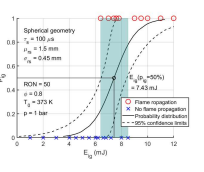
Fluorinated refrigerants (HFCs/HFOs) exhibit a complex and often borderline ignition behavior compared to conventional hydrocarbons. Safety-related investigations show that, even under identical boundary conditions and with the same ignition energy, an ignition may occur in one experiment but fail in another. This stochastic nature of ignition poses a challenge for deterministic models, which treat physical parameters such as ignition radius, energy input, or reaction onset solely as fixed quantities.
The aim of this work is to extend the ignition modeling of fluorinated refrigerants in one-dimensional reaction models (1-D) in such a way that stochastic effects are represented. For selected model parameters (e.g., initial ignition radius, energy input, local temperature rise), statistical distributions are to be defined and integrated into the existing numerical models. The resulting model will then be used to explain and quantify the probabilistic ignition behavior observed experimentally
- Familiarization: Literature review on numerical 1-D ignition models for fluorinated or otherwise hard-to-ignite substances, stochastic ignition modeling, and uncertainty quantification.
- Execution of simulations: Implementation of stochastic parameter distributions and execution of Monte-Carlo-type 1-D simulations to determine ignition probability and probabilistic minimum ignition energy (including regression methods).
- Evaluation / Analysis: Comparison of simulation results with experiments, sensitivity analysis of relevant parameters, and development of a probabilistic model to describe the stochastic ignition behavior.
- Expected results: A stochastically extended 1-D ignition model, a quantitative description of the ignition probability of fluorinated refrigerants, and recommendations for future safety-related assessments.